qEEG is a structured analysis of resting brain activity. In my practice, it is based on eyes-open and eyes-closed EEG recordings, followed by quantitative review across several layers of the signal. The aim is to make the physiology easier to read: where activity is increased or reduced, how regions are interacting, how brain states are organizing over time, and which cortical systems appear most involved.
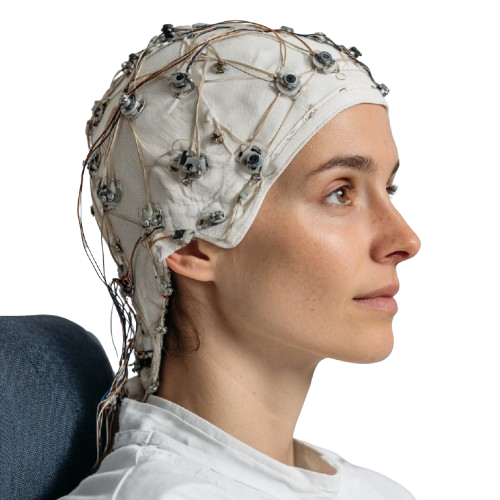
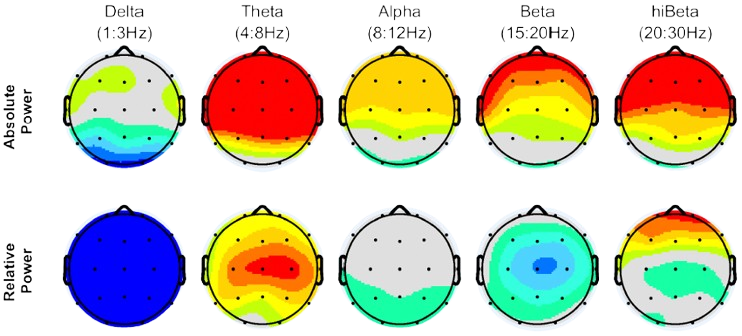
Spectral analysis looks at the strength and distribution of EEG frequencies across the scalp. This includes absolute power, relative power, and related measures such as alpha peak frequency. It can help show whether activity is frontally weighted, posteriorly reduced, broadly accelerated, slowed, or mixed across conditions.
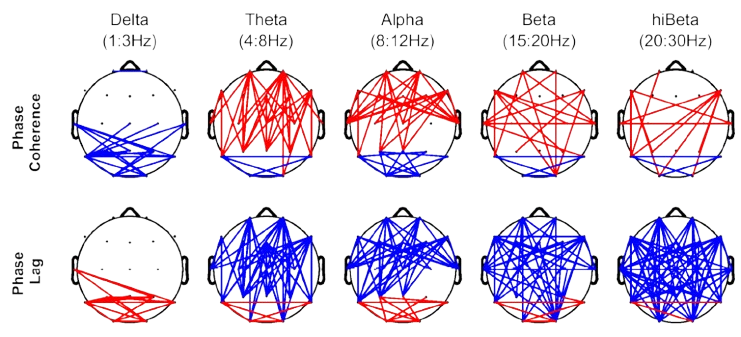
Connectivity analysis looks at how different brain regions relate to one another over time. Depending on the measure, this can include coherence, phase lag, and asymmetry. This layer becomes especially useful when the main issue appears to involve timing, coupling, or network coordination across regions.
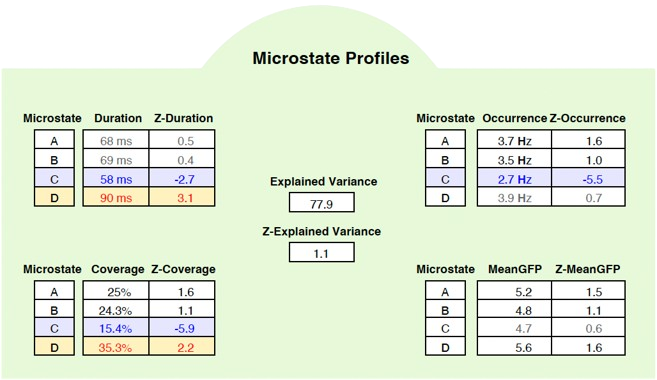
Microstate and dynamics analysis looks at how the brain is organizing itself over time. This includes measures such as duration, coverage, occurrence, explained variance, sample entropy, and fractal dimension. These metrics can be informative when the clinical picture involves instability, reactivity, rapid state shifts, or difficulty maintaining a steady mode of functioning.
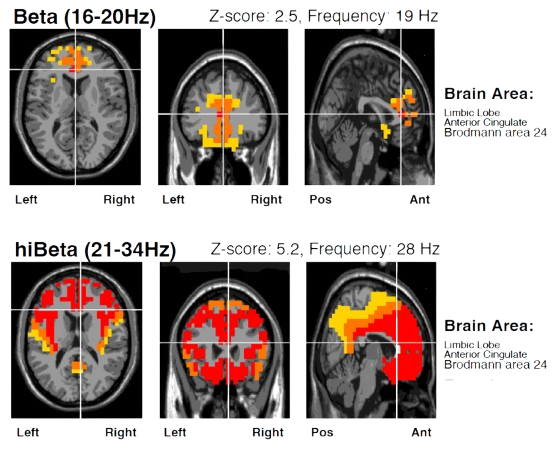
sLORETA is a source-localization model that estimates the most likely cortical generators of scalp EEG patterns. It adds a deeper spatial layer to the assessment by helping organize findings around broader cortical systems and Brodmann areas. In practice, this can be useful when repeated scalp findings appear to converge on frontal control regions, temporal areas, posterior association cortex, or other larger-scale networks.
I use qEEG when a case would benefit from a more detailed physiological map before training begins. Sometimes the most useful signal is spectral. In other cases, the main value comes from connectivity, state dynamics, or source-localized convergence across outputs. This can help guide the next step more precisely — whether that points toward neurofeedback, biofeedback, photobiomodulation, or a broader systems medicine work-up.
For qEEG to be useful, the recording itself has to be solid. That means careful acquisition, thoughtful artifact reduction, review across eyes-open and eyes-closed states, comparison across different montage views when needed, and attention to recording stability before interpretation.
Book an appointment to discuss your situation and decide on the most appropriate starting point.
Book an appointment