Neurofeedback and biofeedback in Neuchâtel

Chronic pain

Your back, neck or jaw has hurt for months, and you have already seen your doctor, physiotherapist or dentist. I offer muscle biofeedback alongside: you watch the tension in your muscles on the screen and learn to release it.

  • Recognized by ASCA and RME: reimbursement possible through your supplementary insurance, depending on your policy.
  • I see patients in French, English and Greek.

★★★★★ 5.0 on Google

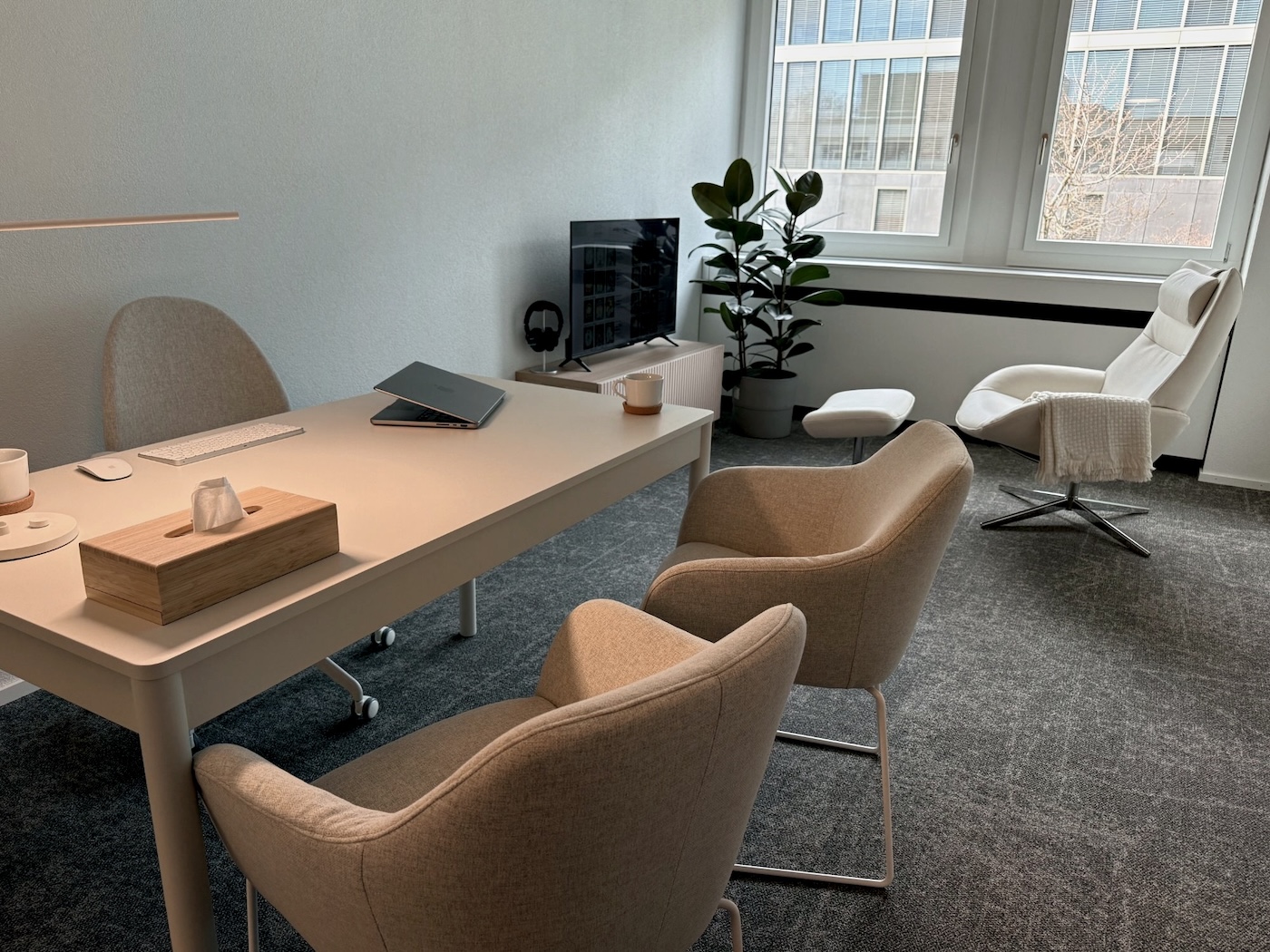
The desk of the first consultation, at the practice in Neuchâtel

What the studies show

The back and neck

In a study of 36 people with chronic low back pain, pain on movement fell by 62% with muscle biofeedback, which teaches the muscles on both sides of the back to work in the same way. It fell by 7% with classes about back pain. Study

In a study of 24 patients with chronic back or neck pain, pain had fallen by 68% two and a half years after muscle biofeedback added to medical treatment. It had fallen by 14% with medical treatment alone or with a simulated biofeedback. Study

In a study of office workers with chronic neck pain, pain had fallen by 3.7 cm on a 10 cm scale six months after shoulder-muscle biofeedback during computer work. It had risen by 0.1 cm in those who received only a booklet on ergonomics. Study

Fibromyalgia

In a study of 40 women with fibromyalgia, pain, rated 8.9 on average at the start, had come down to 1.6 after four weeks of frequency-band neurofeedback. With an antidepressant, escitalopram, it went from 9.1 to 4.7. Study

The jaw

In a study of 94 adults with chronic jaw pain, pain fell by 20 points out of 100 with muscle and temperature biofeedback and relaxation training. It fell by 5.2 points with usual dental care. Study

Muscle biofeedback at the practice

The sensors record the muscle's electrical activity, as an electrocardiogram records the heart's. On the screen you watch the tension rise as the muscle tightens and fall as you release it.

Back and neck

The muscles along the spine

The sensors follow the muscles along the spine and those of the neck and shoulders. The aim is for them to work when needed and relax the rest of the time, so movement becomes more comfortable.

Jaw

The masseter

The sensor follows the muscle that clenches the teeth. The aim is to release the tension around the jaw, with or without a splint.

Neurofeedback

Widespread pain

For widespread pain, and the sleep or anxiety that come with pain, I also offer neurofeedback.

A session at the practice

The sensors

A few sensors on the skin. They measure and send nothing into your body.

The sound

In neurofeedback you listen through headphones to a sound that follows your brain's activity. You have nothing else to do.

The screen

In biofeedback you watch your pulse or the tension in your muscles change on the screen, as in a mirror.

Measurement

A session lasts an hour. I record the signals we train and adjust what follows from those measurements.

5.0 Google reviews

Simon Zünd

★★★★★

I was curious what neurofeedback is, so I went to see Dr Messinis to try it out. He explained everything very precisely, in a way that was easy to understand. He has a very calming presence, which helped me relax.

At my first visit we did a more detailed "scan" of my brain, and afterwards I received a detailed report. Interestingly, many things in the report were quite accurate, for example it said that I am a "visual thinker". That is definitely true, since at work I constantly write things down and sketch.

All in all, I can only recommend Dr Messinis!

translated from German

Book an appointment

One hour at the practice: you tell me where and for how long it has hurt, and what you have already tried. If your doctor asks, I send them a short report.

Book a first consultation
References (5)
  • Donaldson S, Romney D, Donaldson M, Skubick D (1994). Randomized study of the application of single motor unit biofeedback training to chronic low back pain. Journal of Occupational Rehabilitation, 4(1), 23-37. DOI 10.1007/BF02109994. PMID 24234261.
  • Flor H, Haag G, Turk DC (1986). Long-term efficacy of EMG biofeedback for chronic rheumatic back pain. Pain, 27(2), 195-202. DOI 10.1016/0304-3959(86)90210-1. PMID 2948145.
  • Kayıran S, Dursun E, Dursun N, Ermutlu N, Karamürsel S (2010). Neurofeedback intervention in fibromyalgia syndrome; a randomized, controlled, rater blind clinical trial. Applied Psychophysiology and Biofeedback, 35(4), 293-302. DOI 10.1007/s10484-010-9135-9. PMID 20614235.
  • Ma C, Szeto GP, Yan T, Wu S, Lin C, Li L (2011). Comparing biofeedback with active exercise and passive treatment for the management of work-related neck and shoulder pain: a randomized controlled trial. Archives of Physical Medicine and Rehabilitation, 92(6), 849-58. DOI 10.1016/j.apmr.2010.12.037. PMID 21621660.
  • Mishra KD, Gatchel RJ, Gardea MA (2000). The relative efficacy of three cognitive-behavioral treatment approaches to temporomandibular disorders. Journal of Behavioral Medicine, 23(3), 293-309. DOI 10.1023/a:1005562126071. PMID 10863679.