Neurofeedback and biofeedback in Neuchâtel

Tinnitus

If you have tinnitus, you have usually already had your ears examined and your hearing tested by an ENT specialist. I work with you on how much room the sound takes up, so that it intrudes less, and on what comes with it: anxiety, low mood, stress, sleep, tension headaches, a tight jaw or neck.

  • Recognized by ASCA and RME: reimbursement possible through your supplementary insurance, depending on your policy.
  • I see patients in French, English and Greek.

★★★★★ 5.0 on Google

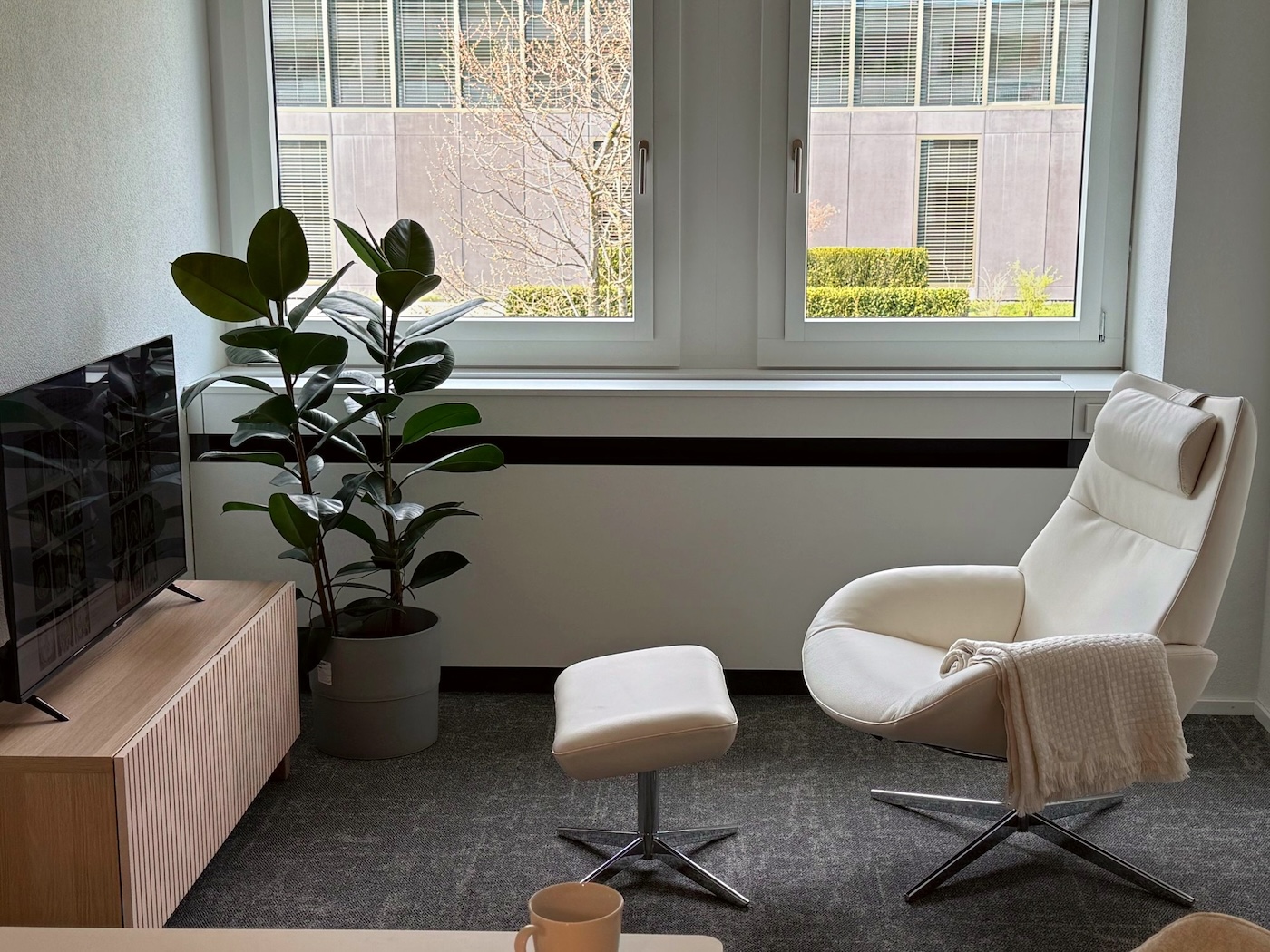
The treatment chair by the window

What happens in the brain

Tinnitus means hearing ringing, buzzing or another sound that has no outside source. It often starts after hearing damage from age or noise, sometimes even when a standard hearing test looks normal. Fewer signals then reach the brain.

Along the hearing pathways, up to the auditory cortex, the balance shifts between activity that excites nerve cells and activity that holds them back. Some nerve cells start firing on their own, in bursts and together: researchers see this as the source of the sound you hear. Signals from the jaw and neck also act on these pathways.

What the studies show

Tinnitus

In a study of 431 patients with tinnitus, the handicap caused by tinnitus had fallen by 28 points three months after a program of skin-conductance, breathing and muscle biofeedback, with breathing and relaxation exercises. It had fallen by 1.4 points with the usual tinnitus medicines. Study

In a study of 130 people with chronic tinnitus, the distress caused by tinnitus fell by 22 points on a scale of 0 to 84 with a behavioral therapy built around muscle biofeedback. It fell by 5.4 points without treatment. Study

The jaw

In a study of 94 adults with chronic jaw pain, pain fell by 20 points out of 100 with muscle and temperature biofeedback and relaxation training. It fell by 5.2 points with usual dental care. Study

What the sessions aim for

I choose the method for you, from your measurements and what weighs on you most.

Neurofeedback

Low frequency

The method I use most. It trains the slowest changes in the brain's activity and aims at a calmer, steadier level of alertness.

Neurofeedback

Frequency bands

It works on the rhythms around the auditory cortex: more alpha, the rhythm of rest, and less slow delta activity. The goal is for the tinnitus to intrude less.

Neurofeedback

Slow cortical potentials

It trains the slow shifts in the cortex's activity, so that it fires up less easily.

Biofeedback

Jaw and neck

Muscle biofeedback releases long-held tension and changes the signals these muscles send into the hearing pathways.

Biofeedback

Skin conductance

It rises when the body goes on alert. Training quiets that alarm, so the tinnitus catches less of your attention.

Biofeedback

Finger temperature

You learn to warm your fingertips: work on relaxation and your sense of control.

A session at the practice

The sensors

A few sensors on the head, or on the jaw and neck. They measure and send nothing into your body.

Sound or screen

In neurofeedback you listen through headphones to a sound that follows your brain. In biofeedback you watch your measurements on the screen.

Measurement

At every session I record the signals we work on and adjust what follows from those measurements.

With your other care

If you wear a hearing aid or are in therapy, the sessions run alongside it.

5.0 Google reviews

Alicja Wyt

★★★★★

I had a very good experience with the biofeedback sessions with Mr Messinis. He is kind, attentive, and really takes the time to listen and explain everything.

After few biofeedback sessions, I've noticed an improvement, specially in my sleep, which has made a positive difference for me.

I appreciated Dr Messinis approach and felt listened to throughout the process. I would recommend him to anyone looking for support with stress and well-being.

Book an appointment

One hour at the practice to go through the history of your tinnitus, the tests you have had and what weighs on you most. If you wish, I send your doctor a short report.

Book a first consultation
References (3)
  • Buizza C, Franco E, Ghilardi A, Cela H (2025). A Brief Biofeedback Training, Integrated with Breathing and Relaxation Exercises, in Treating Tinnitus Disorders within Routine Medical Care. Applied Psychophysiology and Biofeedback, 50(3), 453-464. DOI 10.1007/s10484-025-09694-1. PMID 39913019.
  • Mishra KD, Gatchel RJ, Gardea MA (2000). The relative efficacy of three cognitive-behavioral treatment approaches to temporomandibular disorders. Journal of Behavioral Medicine, 23(3), 293-309. DOI 10.1023/a:1005562126071. PMID 10863679.
  • Weise C, Heinecke K, Rief W (2008). Biofeedback-based behavioral treatment for chronic tinnitus: results of a randomized controlled trial. Journal of Consulting and Clinical Psychology, 76(6), 1046-57. DOI 10.1037/a0013811. PMID 19045972.