Neurofeedback and biofeedback in Neuchâtel

Anxiety and panic attacks

A panic attack comes on suddenly: your heart races, you are short of breath and afraid you are having a heart attack. Anxiety settles in more slowly: you worry almost every day and sleep badly. I offer neurofeedback and biofeedback, to help your brain and body find calm again.

  • Recognized by ASCA and RME: reimbursement possible through your supplementary insurance, depending on your policy.
  • I see patients in French, English and Greek.

★★★★★ 5.0 on Google

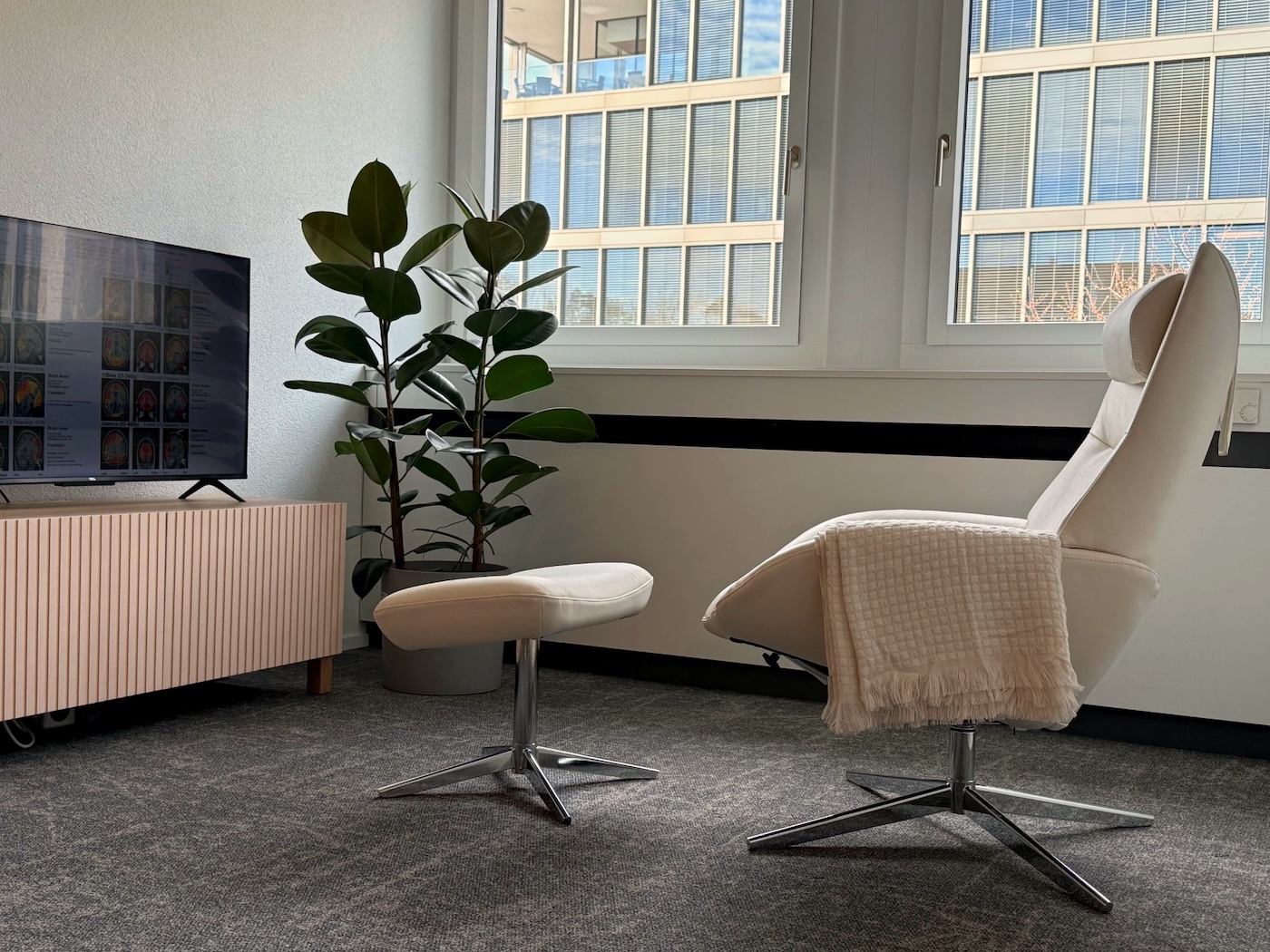
The treatment chair at the practice in Neuchâtel

What the studies show

Anxiety

In a study of 28 patients with generalized anxiety disorder, anxiety, rated by a psychologist on a scale of 0 to 21, fell by 11 points with alpha-theta neurofeedback. It rose by 0.1 points in the patients on the waiting list. Study

In a study of people from a university community with high anxiety, felt anxiety fell by 5.7 points on a scale of 0 to 21 with alpha-theta neurofeedback combined with guided imagery. It fell by 0.3 points with a simulated neurofeedback using prerecorded sounds. Study

Anxiety attacks and panic

In a study of anxious patients who had anxiety attacks, the score for the attacks and their impact fell by 6.8 points one month after breathing biofeedback, with breathing exercises at home. It fell by 1.6 points in the patients on the waiting list. Study

In a study of 43 adults with panic disorder, the severity of the disorder, rated by a clinician on a scale of 0 to 4, fell by 1.5 points with breathing training guided by a measure of the carbon dioxide in the breath. It fell by 0.03 points on the waiting list. Study

After a trauma

In a study of 40 people with post-traumatic stress disorder, symptoms rated by a clinician fell by 13 points with frequency-band neurofeedback. They fell by 7.2 points with a simulated neurofeedback. Study

What the sessions aim for

Your doctor has usually checked your heart and thyroid, and suggested psychotherapy or medication. The sessions run alongside.

Biofeedback

Heart rate variability

You watch your pulse rise as you breathe in and fall as you breathe out. Training aims at slow breathing, at the pace where these changes are widest.

Neurofeedback

Frequency bands

The sound follows a specific rhythm of your brain, such as alpha or the sensorimotor rhythm. Training aims at steadier attention when a worry takes hold.

Neurofeedback

Low frequency

It follows the very slow changes in your brain's activity and aims at a steadier level of arousal.

Biofeedback

Muscle tension

You watch a muscle's tension drop on the screen as you release it.

If exhaustion or sleep weighs on you most, see also Burnout and exhaustion and Insomnia and sleep problems.

A session at the practice

The sensors

A few sensors on the skin. They measure and send nothing into your body.

The sound

In neurofeedback you listen through headphones to a sound that follows your brain's activity. You have nothing else to do.

The screen

In biofeedback you watch your pulse or the tension in your muscles change on the screen, as in a mirror.

Measurement

A session lasts an hour. I record the signals we train and adjust what follows from those measurements.

5.0 Google reviews

Simon Zünd

★★★★★

I was curious what neurofeedback is, so I went to see Dr Messinis to try it out. He explained everything very precisely, in a way that was easy to understand. He has a very calming presence, which helped me relax.

At my first visit we did a more detailed "scan" of my brain, and afterwards I received a detailed report. Interestingly, many things in the report were quite accurate, for example it said that I am a "visual thinker". That is definitely true, since at work I constantly write things down and sketch.

All in all, I can only recommend Dr Messinis!

translated from German

Book an appointment

One hour at the practice to go over what your doctors have checked and what you have already tried. I then suggest a method and explain why.

Book a first consultation
References (5)
  • Dadashi M, Birashk B, Taremian F, Asgarnejad AA, Momtazi S (2015). Effects of Increase in Amplitude of Occipital Alpha & Theta Brain Waves on Global Functioning Level of Patients with GAD. Basic and Clinical Neuroscience, 6(1), 14-20. PMID 27504152.
  • Dinc L, Rybski D, Dineen J (2025). The effects of alpha/theta neurofeedback on mood, anxiety, emotion regulation and trait impulsivity. Brain Research, 1866, 149943. DOI 10.1016/j.brainres.2025.149943. PMID 40945564.
  • Kim S, Roth WT, Wollburg E (2015). Effects of therapeutic relationship, expectancy, and credibility in breathing therapies for anxiety. Bulletin of the Menninger Clinic, 79(2), 116-30. DOI 10.1521/bumc.2015.79.2.116. PMID 26035087.
  • Meuret AE, Wilhelm FH, Ritz T, Roth WT (2008). Feedback of end-tidal pCO2 as a therapeutic approach for panic disorder. Journal of Psychiatric Research, 42(7), 560-8. DOI 10.1016/j.jpsychires.2007.06.005. PMID 17681544.
  • Nicholson AA, Densmore M, Frewen PA, Neufeld RWJ, Théberge J, Jetly R, et al. (2023). Homeostatic normalization of alpha brain rhythms within the default-mode network and reduced symptoms in post-traumatic stress disorder following a randomized controlled trial of electroencephalogram neurofeedback. Brain Communications, 5(2), fcad068. DOI 10.1093/braincomms/fcad068. PMID 37065092.