Neurofeedback and biofeedback in Neuchâtel

Migraine and headaches

Migraine attacks that keep coming back, or tension headaches several days a month. Your doctor has usually identified which it is and prescribed treatment for the attacks. I offer biofeedback alongside, to release the muscles of the forehead and neck or warm your hands, and neurofeedback.

  • Recognized by ASCA and RME: reimbursement possible through your supplementary insurance, depending on your policy.
  • I see patients in French, English and Greek.

★★★★★ 5.0 on Google

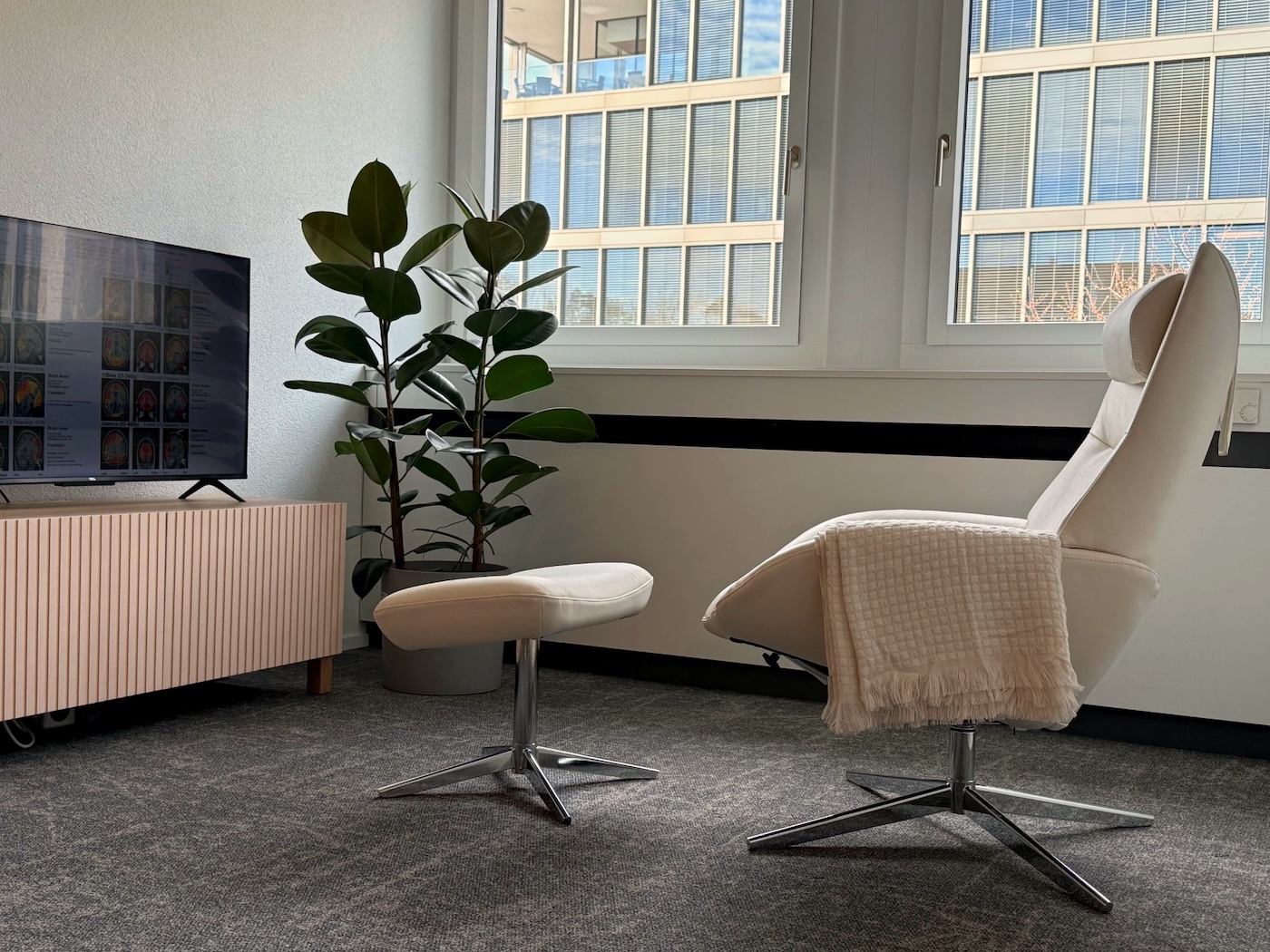
The treatment chair at the practice in Neuchâtel

What the studies show

Migraine

In a study of 22 women with migraine, headache intensity, rated each day and added up over five weeks, fell by 109 points with hand-temperature biofeedback. It rose by 23 points in the women on the waiting list. Study

In a study of 21 women with migraine, the same five-week total fell by 42 points with biofeedback of the pulse in the temple artery, which trains the artery to widen. It rose by 12 points on the waiting list. Study

In a study of adults with migraine who had responded to treatment, migraine came back 82% less often in the following year after biofeedback of the muscles and of temperature, combined with breathing and relaxation, than after propranolol, a preventive migraine medicine. Study

Tension headaches

In a study of 375 adults who had both migraine and tension headaches, the weekly headache index, which combines how often and how badly the head hurts, fell by 6 points with biofeedback of the muscles and of temperature combined with two preventive medicines. It fell by 1.5 points with medicines taken during attacks. Study

In a study of 31 patients with tension headaches, headache intensity, rated from 0 to 5 in a diary, fell by 1.1 points with skin-conductance biofeedback. It fell by 0.3 points with autogenic training, a relaxation method. Study

What the sessions aim for

The sessions run alongside your treatments.

Biofeedback

The muscles

You practice lowering the tension of the forehead, neck and shoulders, often tighter in tension headaches. The aim is for them to send fewer pain signals.

Biofeedback

Hand temperature

You practice warming your hand as you relax. The aim is to calm your stress reactions and give you more control over your attacks.

Neurofeedback

Low frequency

The sound follows the very slow changes in the brain's activity, linked to its excitability. Training aims at a steadier brain, less inclined to amplify pain.

Biofeedback

Skin conductance

It follows the body's state of alert. Training also aims to calm stress reactions.

A session at the practice

The sensors

A few sensors on the skin. They measure and send nothing into your body.

The sound

In neurofeedback you listen through headphones to a sound that follows your brain's activity. You have nothing else to do.

The screen

In biofeedback you watch your pulse or the tension in your muscles change on the screen, as in a mirror.

Measurement

A session lasts an hour. I record the signals we train and adjust what follows from those measurements.

5.0 Google reviews

Simon Zünd

★★★★★

I was curious what neurofeedback is, so I went to see Dr Messinis to try it out. He explained everything very precisely, in a way that was easy to understand. He has a very calming presence, which helped me relax.

At my first visit we did a more detailed "scan" of my brain, and afterwards I received a detailed report. Interestingly, many things in the report were quite accurate, for example it said that I am a "visual thinker". That is definitely true, since at work I constantly write things down and sketch.

All in all, I can only recommend Dr Messinis!

translated from German

Book an appointment

One hour at the practice to look at your headaches and treatments together. I then suggest a method. If your doctor asks, I send them a short report.

Book a first consultation
References (5)
  • Collet L, Cottraux J, Juenet C (1986). GSR feedback and Schultz relaxation in tension headaches: a comparative study. Pain, 25(2), 205-213. DOI 10.1016/0304-3959(86)90094-1. PMID 3523395.
  • Gauthier J, Doyon J, Lacroix R, Drolet M (1983). Blood volume pulse biofeedback in the treatment of migraine headache: a controlled evaluation. Biofeedback and Self-Regulation, 8(3), 427-42. DOI 10.1007/BF00998751. PMID 6671106.
  • Gauthier J, Lacroix R, Coté A, Doyon J, Drolet M (1985). Biofeedback control of migraine headaches: a comparison of two approaches. Biofeedback and Self-Regulation, 10(2), 139-59. DOI 10.1007/BF01000750. PMID 3914314.
  • Kaushik R, Kaushik RM, Mahajan SK, Rajesh V (2005). Biofeedback assisted diaphragmatic breathing and systematic relaxation versus propranolol in long term prophylaxis of migraine. Complementary Therapies in Medicine, 13(3), 165-74. DOI 10.1016/j.ctim.2005.04.004. PMID 16150370.
  • Mathew NT (1981). Prophylaxis of migraine and mixed headache. A randomized controlled study. Headache, 21(3), 105-109. DOI 10.1111/j.1526-4610.1981.hed2103105.x. PMID 7021472.